In February, two client invoices land in the same week and your bank balance jumps to ₦850,000. You clear overdue bills, restock the house, upgrade your workspace, and help a sibling with school fees. By May, a major client delays payment for six weeks, a project stalls, and your total inflow for the month drops to ₦220,000. Yet your landlord, internet provider, electricity meter, and stomach still demand the exact same Naira on schedule.
Most standard budgeting rules fail freelancers, consultants, commission earners, and small business owners because those rules assume a predictable paycheck arrives on the 25th of every month. When you try to apply a fixed 50/30/20 percentage split to an income that swings between ₦220,000 and ₦1,100,000, you end up over-committing during booming months and scrambling for high-interest credit during lean ones.
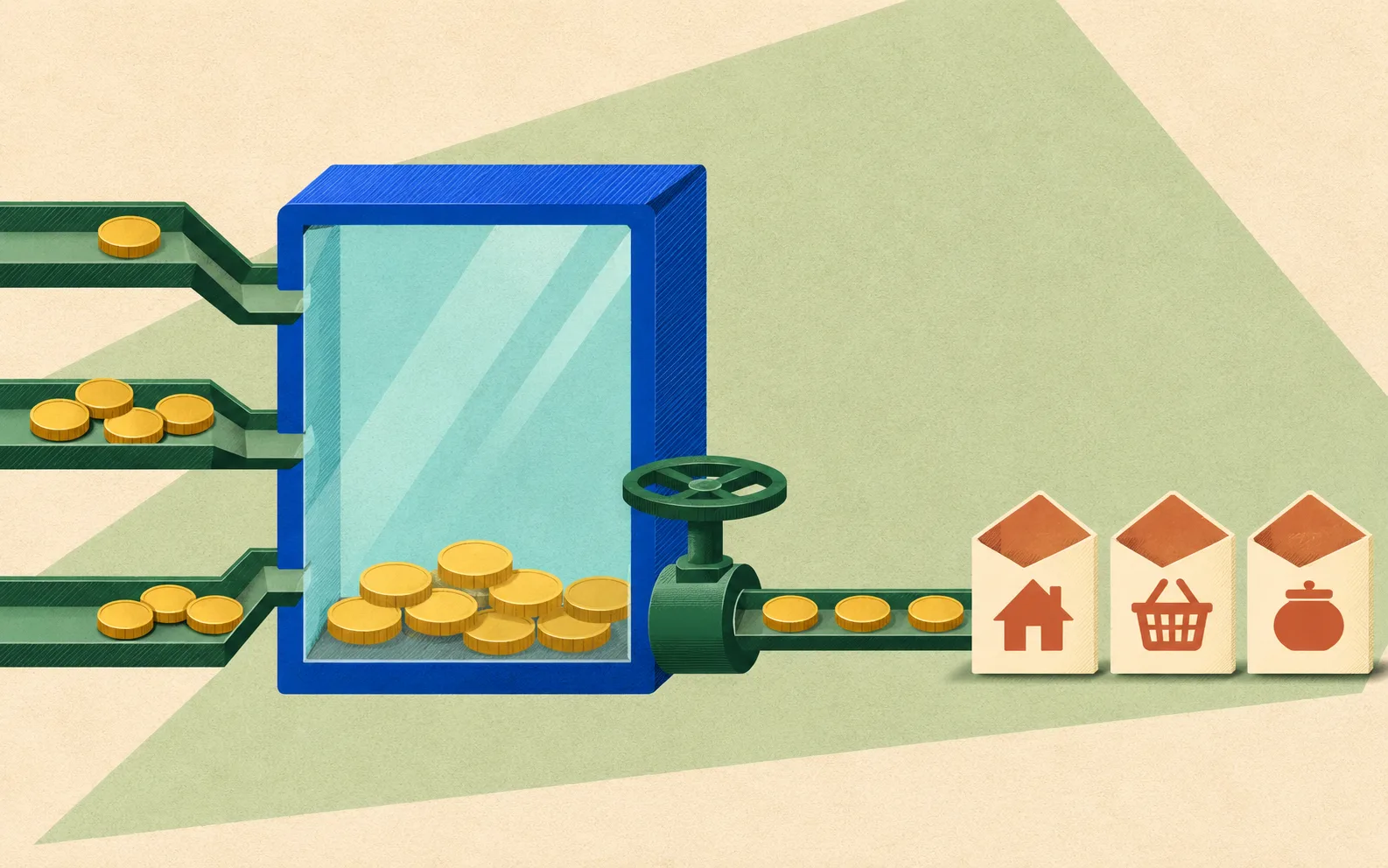
Learning how to budget with irregular income does not require predicting what clients or customers will pay next month. Instead, as financial empowerment guidance from the Consumer Financial Protection Bureau (CFPB) and Utah State University Extension explains, it requires separating your business inflows from your personal pocket, sizing your core lifestyle around a conservative baseline floor, and using an income-smoothing buffer account to pay yourself a steady monthly salary whether sales are booming or quiet.
KEY TAKEAWAYS
- Gross business inflow is not your personal take-home pay: Every client payment or shop sale must first cover direct delivery costs, equipment replacement, and taxes before you transfer a single Naira to your personal spending account.
- Budget from your lowest survival baseline, not your best month: Building your fixed monthly commitments around your leanest recent month (or 70% to 80% of your 12-month average) protects you when invoices arrive late.
- An income-smoothing buffer turns erratic revenue into a regular salary: All net business income goes into a holding account first, and that holding account pays your personal bank account the same fixed monthly salary on the first of every month.
- Prioritize expenses in tiers so you know what to pause in a dry spell: Grouping expenses into Tier 1 survival essentials, Tier 2 sinking funds (annual rent, taxes, and pension), and Tier 3 flexible wants gives you an automatic action plan when cash flow dips.
- Missing tax details on invoices shrinks your cash flow upfront: Under Nigeria's Deduction of Tax at Source (Withholding) Regulations 2024, corporate clients deduct 5% Withholding Tax on resident consultancy and professional fees, and that deduction doubles to 10% if your invoice lacks a valid Taxpayer Identification Number (TIN).
Why Traditional Budgets Break Down When Your Income Fluctuates
Before blaming yourself for lack of discipline during slow months, look at the structural pressures that make self-employed cash flow difficult to manage in Nigeria.
First, when you earn money and when you get paid are rarely the same date. According to PwC Nigeria's MSME Survey and the 2024 PwC MSME Survey Report, micro, small, and medium enterprises account for 96.9% of Nigerian businesses (with 96.2% operating as sole proprietorships), yet 33% of surveyed MSMEs reported that large corporate clients delayed their payments for more than a month. You can have a profitable quarter on paper and still run out of cash to buy fuel or pay rent on Tuesday.
Second, mixing business turnover with personal spending hides your true income. When a trader, caterer, or freelance developer receives ₦500,000 into the same personal bank account used for groceries and family transfers, the brain reads the entire ₦500,000 as available cash. Weeks later, when it is time to restock inventory, renew software subscriptions, or pay annual taxes, the working capital is gone.
Third, pegging your lifestyle to your highest-earning month creates a permanent cash-flow trap. If you sign a tenancy agreement or take on recurring household commitments based on a rare ₦1,100,000 month, an ordinary ₦350,000 month suddenly feels like an emergency.
3 Questions to Answer Before You Build Your Budget
Before choosing a budgeting method or moving money between accounts, establish the boundaries of your business and household cash flow by answering three questions:
What percentage of every Naira I collect actually belongs to the business? If you sell physical goods (such as food, clothing, or electronics), 50% to 75% of every sale may need to go straight back into restocking inventory and logistics. If you sell digital or professional services (such as software development, design, writing, or consulting), 15% to 25% typically needs to stay behind for mobile data, backup power, software tools, equipment replacement, and taxes.
How wide is the gap between my best month and my worst month? Pull your bank statements from the last 6 to 12 months. Someone whose monthly net income varies mildly between ₦350,000 and ₦450,000 can budget differently from a project contractor who earns ₦1,500,000 one month and ₦0 for the next two months.
Which upcoming annual bills are already ticking in the background? In Nigeria, house rent, school fees, professional licenses, and generator or laptop replacements arrive in large lump sums. Your monthly budget has to fund one-twelfth of those annual bills every single month, not hope for a lucky contract the week before rent is due.
A 6-Step System to Budget With Irregular Income in Nigeria
The six steps below turn unpredictable freelance or business receipts into a calm, repeatable monthly system.
Step 1: Separate Your Business Receiving Account From Your Personal Account
As both the U.S. Small Business Administration (SBA) and the Internal Revenue Service (IRS) small-business recordkeeping guide emphasize, keeping business and personal money in the same bank account makes it nearly impossible to track true profitability or document deductible business expenses at tax time.
Even if you operate as an unregistered freelancer or a registered Business Name (sole proprietorship), set up a Three-Account Architecture:
- Account 1: The Business Receiving and Operations Account: Every client payment, customer transfer, or foreign-currency conversion lands here first. Business expenses (inventory, packaging, internet data, work fuel, software, and subcontractor fees) are paid strictly from this account.
- Account 2: The Income-Smoothing Buffer and Tax Reserve (Money Market Fund or High-Yield Vault): After deducting business operating costs from Account 1, sweep the remaining net profit and tax reserve here. Because this money sits outside your daily spending app, you are not tempted to spend a big client check the week it arrives, and you avoid crossing the Central Bank of Nigeria (CBN) four-withdrawal monthly limit on savings interest.
- Account 3: Your Personal Salary Account: On the 1st of every month, transfer one fixed "owner's salary" from Account 2 into Account 3. You run your entire personal and household life out of Account 3, just like a salaried employee.
Step 2: Calculate Your Bare-Bones Survival Baseline
Next, figure out the minimum monthly salary Account 3 needs to keep your household safe, fed, and working. Follow the two-method comparison recommended by Utah State University Extension's irregular-income guide:
- The Lowest-Month Method (Best for wide income swings or new freelancers): Look at your net business income (after business expenses and tax set-asides) over the past 6 to 12 months and pick the lowest single month.
- The Conservative Average Method (Best when you already have a 2-to-3-month cash buffer): Add up your net business income over the past 12 months, divide by 12 to find your monthly average, and multiply by 0.75 or 0.80 to create a 20% to 25% safety margin.
Next, total up your Tier 1 Bare-Bones Household Essentials:
- Monthly rent set-aside (annual rent plus service charge divided by 12)
- Basic groceries, cooking gas, and drinking water
- Essential transport, electricity tokens, and home utility bills
- Essential healthcare, children's schooling, and a fixed, non-negotiable cap for core family support
Your fixed monthly owner's salary should cover Tier 1 Essentials plus your Tier 2 Sinking Funds and Savings (emergency fund contributions, laptop/equipment replacement, and retirement).
Step 3: Use the Income-Smoothing Buffer to Pay Yourself a Fixed Monthly Salary
Here is where most freelancers go wrong: in a ₦900,000 month, they transfer ₦700,000 to themselves, and in a ₦200,000 month, they transfer ₦150,000 and borrow to cover the rest.
With an income-smoothing buffer, your personal lifestyle stays flat while the buffer absorbs the peaks and valleys. Look at an illustrative six-month cash-flow table for a Nigerian freelancer or small service business owner whose gross client inflows swing between ₦220,000 and ₦1,100,000:
- Business and Tax Rule: Every time a client pays, 20% stays behind for business operating expenses (12%) and tax reserves (8%). The remaining 80% moves into the Income-Smoothing Buffer Account.
- Fixed Owner Salary Rule: The owner's bare-bones living cost is ₦240,000 a month, plus ₦60,000 for monthly rent/emergency savings and pension. So on the 1st of every month, the buffer pays the owner a fixed salary of ₦300,000.00.
- Starting Point: The owner begins Month 1 (January) with a modest ₦150,000.00 starting buffer.
Month | Gross Client Inflows Received | Less 20% Business Ops & Tax Reserve | Net Cash Added to Buffer (80%) | Fixed Owner Salary Paid Out | Monthly Buffer Surplus or Deficit | Ending Income-Smoothing Buffer Balance |
Month 1 (Jan) | ₦280,000.00 | -₦56,000.00 | ₦224,000.00 | -₦300,000.00 | -₦76,000.00 | ₦74,000.00 |
Month 2 (Feb) | ₦850,000.00 | -₦170,000.00 | ₦680,000.00 | -₦300,000.00 | +₦380,000.00 | ₦454,000.00 |
Month 3 (Mar) | ₦320,000.00 | -₦64,000.00 | ₦256,000.00 | -₦300,000.00 | -₦44,000.00 | ₦410,000.00 |
Month 4 (Apr) | ₦1,100,000.00 | -₦220,000.00 | ₦880,000.00 | -₦300,000.00 | +₦580,000.00 | ₦990,000.00 |
Month 5 (May) | ₦220,000.00 | -₦44,000.00 | ₦176,000.00 | -₦300,000.00 | -₦124,000.00 | ₦866,000.00 |
Month 6 (Jun) | ₦530,000.00 | -₦106,000.00 | ₦424,000.00 | -₦300,000.00 | +₦124,000.00 | ₦990,000.00 |
6-Month Total / Avg | ₦3,300,000.00 (₦550k/mo avg) | -₦660,000.00 (₦110k/mo avg) | ₦2,640,000.00 (₦440k/mo avg) | -₦1,800,000.00 (₦300k/mo fixed) | +₦840,000.00 net added | ₦990,000.00 (3.3 mos of salary) |
Look at what happens in Month 5 (May) in the table above. Gross client inflows drop to ₦220,000, leaving only ₦176,000 after business and tax deductions. Without a buffer, the owner would face a ₦124,000 shortfall and might turn to a high-interest loan app. Because the surpluses from February (+₦380,000) and April (+₦580,000) were parked in the buffer instead of spent on impulse upgrades, the owner still receives their full ₦300,000.00 salary on May 1st and finishes June with ₦990,000.00 in reserve.
Step 4: Organize Your Personal Budget Into Three Priority Tiers
Even with a buffer, a freelancer starting from zero savings may experience a slow first quarter before the buffer is fully funded. Using a tiered priority budget, modeled on the CFPB's Your Money, Your Goals cash-flow framework, removes guesswork when money is tight. You fund Tier 1 completely before spending a kobo on Tier 2, and fund Tier 2 before touching Tier 3:
- Tier 1: Survival and Earning Continuity (Funded First Every Month): Food, Monthly Rent Set-Aside, Work Internet/Power, Essential Transport, and Minimum Debt Payments. If you cannot work or keep a roof over your head, your income drops to zero.
- Tier 2: Protection and Future Stability (Funded Second): Emergency Fund Top-Ups, Annual Sinking Funds (school fees, equipment replacement, health insurance), and Retirement Contributions.
- Tier 3: Lifestyle Wants and Extra Giving (Funded Only When Buffer Target Is Met): Dining out, new clothes, travel, gadget upgrades, and non-emergency social or extended-family requests above your monthly cap.
Once your Income-Smoothing Buffer reaches 3 to 6 months of your fixed owner's salary (₦900,000 to ₦1,800,000 in the example above), you can reward yourself at the end of every quarter by taking a fixed percentage (such as 25% to 30%) of the surplus above that cap for lifestyle upgrades or long-term investments.
Step 5: Protect Your Invoices From Tax Surprises and Double WHT Deductions
Nothing wrecks a freelancer's or contractor's cash-flow forecast faster than expecting ₦1,000,000 from a corporate client and receiving ₦825,000 without understanding why.
Under Nigeria's Deduction of Tax at Source (Withholding) Regulations 2024 (which took effect for corporate deductions in January 2025) and the Nigeria Tax Act 2025 (effective January 2026), as summarized by Andersen in Nigeria, PwC Nigeria, and Billify's 2026 WHT compliance guide:
- Standard Withholding Tax (WHT) rates on invoices: Corporate clients are legally required to deduct 5% WHT at source on payments to resident recipients for consultancy, professional, management, technical, and commission services, and 2% WHT on contracts for the supply of goods or materials (other than by the manufacturer).
- The missing-TIN penalty doubles your deduction: In non-passive transactions, if you provide goods or services without putting a valid Taxpayer Identification Number (TIN) on your invoice, the client is required by law to double the WHT rate (up to a 20% cap). That turns a 5% consultancy deduction into a 10% deduction on the spot.
- Small-transaction exemption requires both conditions: Small businesses are exempt from WHT deduction on transactions below ₦2,000,000 in a calendar month only if the supplier has a valid TIN.
- Withholding Tax is an advance tax credit, not an extra fee: Whenever a corporate client deducts 5% WHT from your payment, ask for your official WHT Credit Note immediately so you can use it to offset your annual Personal Income Tax (where the first ₦800,000 of annual chargeable income is taxed at 0% under the Nigeria Tax Act 2025) or Companies Income Tax.
- Keep VAT separate from your revenue: If your business is required to charge 7.5% Value Added Tax (VAT) on invoices, sweep that 7.5% into your tax reserve the day the client pays. VAT is government money passing through your hands, not business profit.
Step 6: Build Retirement and Emergency Flexibility With PenCom's Micro Pension Plan
Salaried employees have 8% of their monthly emoluments deducted automatically for retirement alongside a 10% employer contribution. When you work for yourself, nobody funds your retirement unless you build it into your monthly budget.
Many Nigerian freelancers avoid traditional pension accounts because they worry about locking away all their cash until age 50 when business is unpredictable. To solve that exact problem for self-employed professionals, artisans, and informal-sector business owners, the National Pension Commission (PenCom) Micro Pension Plan (MPP) and the PenCom Revised Regulation on Investment of Pension Fund Assets split every contribution you make into two parts:
- 40% Contingent Withdrawal Portion: Kept liquid so you can withdraw from it (including accumulated investment returns) starting just three months after your initial contribution to ease financial pressures during a business downturn.
- 60% Retirement Benefits Portion: Invested and compounded until retirement (from age 50), with the option to convert any unused contingent balance into your retirement pot at the end of each year.
Because there is no fixed minimum contribution amount and you can contribute daily, weekly, or monthly via your chosen Pension Fund Administrator (PFA), adding a Micro Pension transfer to your Tier 2 monthly budget builds long-term security without trapping 100% of your cash.
How to Monitor and Adjust Your Cash-Flow System
An irregular-income budget is a living dashboard, not a static document you write in January and forget. Distinguish your ultimate goal (uninterrupted personal bill payments, zero high-interest borrowing, and growing business equity) from the early warning indicators you check every week and month:
What to Track | When to Review | What the Number Tells You | Action to Take If It Slips |
Unpaid Client Receivables (30+ Days Overdue) | Every Friday afternoon | Whether upcoming months will face a cash-flow dip even though sales look strong on paper | Require a 40% to 50% upfront deposit before starting new client projects; send automated invoice reminders 5 days before due dates |
Income-Smoothing Buffer Runway (Buffer balance divided by your fixed monthly owner salary) | 1st of every month (before paying yourself) | How many months you can pay your full personal salary if new client inflows drop to zero | If buffer drops below 1.5 months of salary, pause all Tier 3 discretionary spending and hold off on owner bonuses until reaches 3 months |
Business Operating & Inventory Ratio (Actual business costs as a % of gross inflows) | End of every month | Whether rising fuel, data, or supplier prices have quietly exceeded your 20% (or inventory) deduction rule | Adjust your automatic business cost retention percentage upward by 5% or reprice your client packages on new quotes |
Withholding Tax (WHT) Credit Note Log | Quarterly (Mar, Jun, Sep, Dec) | Whether corporate clients who deducted 5% WHT from your invoices actually issued your tax credit receipts | Follow up with client finance teams before quarter-end and confirm your TIN is printed clearly on every invoice template |
Sources and review
Written by Sam Olumide. Reviewed and published by Fincalcz Editorial Team. Last updated November 3, 2026. This article is for educational and informational purposes only and does not constitute individualized financial, tax, accounting, or legal advice. Always review your official tax obligations and contracts or consult a licensed accountant or financial professional for guidance tailored to your business.
- Consumer Financial Protection Bureau (CFPB): Your Money, Your Goals: A Financial Empowerment Toolkit and Creating a Cash Flow Budget Tool. Used for cash-flow budgeting mechanics, tracking the week-by-week timing of irregular inflows and expenses, and prioritizing essential survival obligations ahead of discretionary spending.
- Utah State University (USU) Extension: Family Budgeting with an Irregular Income and Our Answers to Your Money Questions (Budgeting for Non-Monthly Expenses). Used to corroborate the two baseline methods for irregular income (basing the monthly budget on the lowest month in the past 6 to 12 months or a conservative average), zero-based allocation, and dividing annual non-monthly expenses by 12.
- U.S. Small Business Administration (SBA): Launch Your Business: Open a Business Bank Account and Internal Revenue Service (IRS): Small Business and Self-Employed Income & Expenses FAQ and Publication 583: Starting a Business and Keeping Records. Used for the foundational requirement to separate business bank accounts from personal spending accounts and disallowing personal living expenses as business deductions.
- PwC Nigeria: PwC MSME Survey Report 2024 and PwC MSME Survey 2020. Used for Nigerian MSME empirical data, including the share of Nigerian businesses operating as micro Enterprises (96.9%) and sole proprietorships (96.2%), the impact of energy and input costs, and the finding that 33% of surveyed MSMEs experience corporate payment delays exceeding one month.
- PwC Nigeria: The Nigerian Tax Reform Acts: Sectoral Analysis and Personal Income Tax Regime, Andersen in Nigeria: Federal Government Gazettes the Deduction of Tax at Source (Withholding) Regulations 2024, and Billify: Withholding Tax on Invoices in Nigeria (2026 Guide). Used for the 0% Personal Income Tax band on the first ₦800,000 of annual chargeable income under the Nigeria Tax Act 2025, the 5% resident WHT rate on consultancy and professional fees, the 2% WHT rate on supply of goods, the doubled WHT penalty when a supplier has no valid TIN, and the conditional ₦2,000,000 monthly small-business exemption.
- National Pension Commission (PenCom): Micro Pension Plan Frequently Asked Questions and Answers and The Revised Regulation on Investment of Pension Fund Assets (September 2025). Used to verify eligibility for self-employed individuals under the Micro Pension Plan, the default allocation split of 40% for Contingent Withdrawal and 60% for Retirement Benefits, and the three-month eligibility rule for accessing the contingent portion.
How We Calculate Our Examples
The six-month Naira (₦) cash-flow table in this article is an illustrative scenario designed to demonstrate how an income-smoothing buffer converts fluctuating freelance or service-business receipts into a fixed monthly personal salary; it is not a financial statement from an actual business or a tax quote. In the table, Gross Client Inflows across Months 1 to 6 (₦280,000, ₦850,000, ₦320,000, ₦1,100,000, ₦220,000, and ₦530,000) sum to ₦3,300,000.00 (a six-month average of ₦550,000.00/month). Each month, 20% of gross inflows is deducted first (12% for direct business operating expenses such as data, work power, and software tools, plus 8% for tax and compliance reserves), totaling ₦660,000.00 over six months. The remaining 80% of gross inflows (₦224,000, ₦680,000, ₦256,000, ₦880,000, ₦176,000, and ₦424,000, totaling ₦2,640,000.00 or an average of ₦440,000.00/month) is transferred into the Income-Smoothing Buffer Account. Starting from an initial buffer balance of ₦150,000.00 at the beginning of Month 1, a fixed monthly owner's salary of ₦300,000.00 (₦240,000 for Tier 1 survival essentials and ₦60,000 for Tier 2 monthly sinking funds and savings) is paid out each month. Each month's Ending Buffer Balance equals the prior month's ending balance plus that month's Net Cash Added (80% of gross) minus the ₦300,000.00 owner salary, finishing Month 6 at ₦990,000.00 (which equals ₦990,000₦300,000=3.3months of full owner salary runway) before any interest earned on the buffer. For product-based retail or manufacturing businesses with high inventory restocking costs, the business deduction percentage will be significantly higher than 20%.